From Military Experience to an Engineering Career: How Veterans Can Build a New Career in BIM and CAD
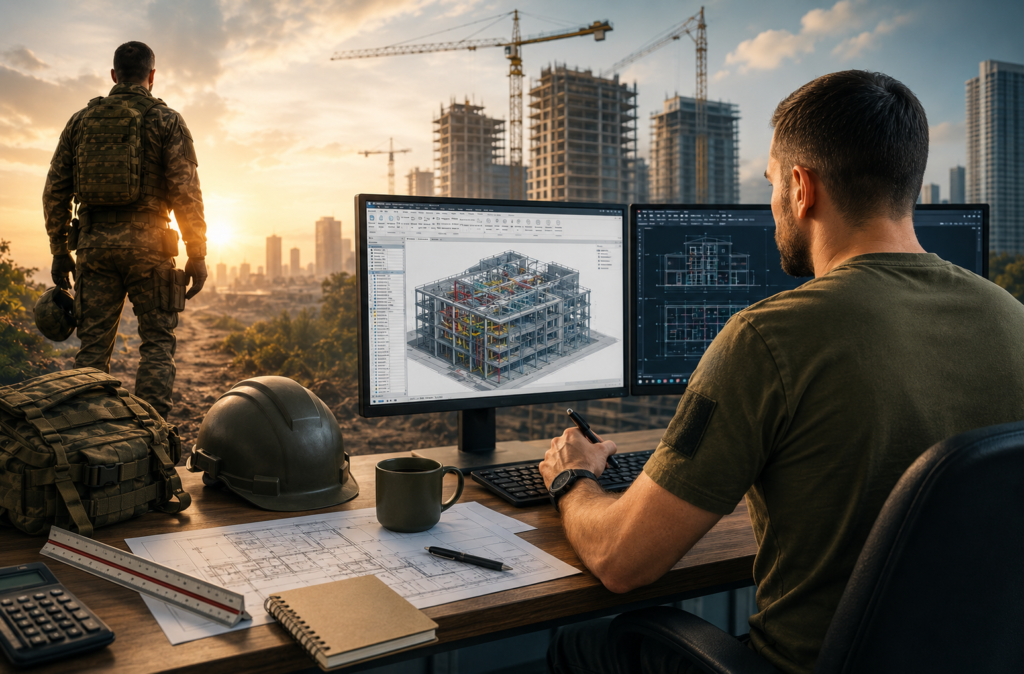
Returning to civilian life involves much more than changing your status. It marks the beginning of a new professional chapter, where veterans redefine their goals, find a new role within a team, and build a long-term career path. For people with technical or engineering experience, this transition offers an opportunity to build on existing strengths instead of starting from scratch.
Engineering, BIM, CAD, Revit, AutoCAD, GIS, and the AEC industry demand far more than software proficiency. Employers look for professionals who demonstrate discipline, attention to detail, responsibility, adaptability, and the ability to follow structured workflows. Military service often develops these qualities naturally, giving veterans valuable advantages as they enter engineering careers.
Rather than asking whether veterans can succeed in engineering, it makes more sense to ask how they can turn their existing experience into a successful career. Practical training, hands-on projects, a strong portfolio, a well-written CV, internships, and entry-level positions all help transform military experience into professional opportunities.
Why Military Experience Can Be an Advantage in Engineering
Engineering professionals rely on much more than software. While learning Revit, AutoCAD, or Civil 3D is essential, these programs are simply tools that support engineering expertise.
Successful engineers pay close attention to details, think logically, collaborate with colleagues, and take responsibility for their work. A single modeling mistake, incorrect dimension, or coordination issue can affect an entire project, making accuracy and consistency critical throughout every stage of the design process.
Many veterans already possess the qualities engineering companies value most:
- Discipline
- Attention to detail
- Ability to follow established processes
- Responsibility for results
- Ability to adapt quickly
- Team collaboration
These qualities go far beyond résumé buzzwords. They represent practical workplace skills that engineering teams rely on every day.
BIM and CAD Are More Than Just Drawing
Many people associate CAD with creating drawings in AutoCAD and BIM with building 3D models in Revit. In reality, both technologies play a much larger role in modern engineering.
CAD enables engineers to produce accurate drawings, plans, diagrams, and technical documentation. BIM expands this process by creating intelligent digital models that contain geometry, parameters, technical information, and relationships between every project element.
For example, an engineer working in Revit does much more than model a pipe, wall, or façade component. Every object becomes part of a connected building system that must coordinate with other disciplines, appear correctly in documentation, and remain understandable for everyone involved in the project.
This type of work requires strong systems thinking, analytical skills, and careful coordination—qualities that many veterans already developed during military service.
Where Should Veterans Start If They Want to Move into BIM or CAD?
Newcomers do not need to master every engineering discipline immediately. Revit, AutoCAD, GIS, Civil 3D, MEP, and structural design each focus on different areas and require different skill sets.
Choosing one clear direction creates the strongest foundation.
Choose the direction that best matches your interests and career goals.
AutoCAD is an excellent starting point for people who enjoy technical drawings, precise documentation, and detailed drafting.
Those interested in building design, engineering systems, digital coordination, and 3D modeling should consider learning Revit and BIM.
Civil 3D or GIS may be the better choice for professionals who want to work with infrastructure, transportation projects, terrain modeling, mapping, or geospatial data.
Your first decision does not need to be perfect. It simply needs to move you forward.
Why Practical Experience Is More Important Than Simply Completing a Course
Reading theory alone will not prepare you for a career in BIM or CAD. You can complete dozens of online lessons and still feel uncertain when solving your first real engineering task.
Hands-on practice builds real confidence. Create technical drawings, model simple projects, prepare documentation sheets, fix mistakes, review feedback, and complete projects from beginning to end. Every practical assignment develops skills that employers want to see.
Recruiters rarely focus on how many courses you completed. Instead, they evaluate what you can actually demonstrate.
Even a small portfolio containing educational projects often creates a stronger impression than a long CV because it proves you already know how to apply your knowledge in practice.
How to Prepare for Your First Job or Internship
Veterans preparing for an engineering career should focus on three essentials: choosing a specialization, creating a professional CV, and building a practical portfolio.
Your CV should present military service as valuable professional experience rather than a career gap. Explain how your service strengthened your responsibility, teamwork, discipline, ability to work within structured environments, and performance under pressure.
Your portfolio can include educational drawings, BIM models, documentation sheets, floor plans, technical diagrams, or small engineering projects. Employers want to see evidence that you can solve practical problems.
You do not need to become the perfect candidate before applying. Junior positions and internships exist to help motivated professionals gain experience, develop their skills, and grow within the industry.
Where Does AI Fit In?
Artificial intelligence continues to reshape the engineering industry, but it does not replace engineers. Instead, it makes their work faster and more efficient.
AI helps automate repetitive tasks, explains technical concepts, assists with quality checks, generates templates, and supports routine workflows. Engineers still make the decisions, solve complex problems, and take responsibility for project quality.
The professionals who combine engineering expertise with BIM, CAD, and AI tools will build the strongest careers in the years ahead.
Veterans can benefit from this shift by entering the industry with modern workflows from the very beginning instead of relying on outdated methods.
A New Career Does Not Begin with Perfect Readiness
Many people postpone career changes because they believe they need to learn more before taking the first step.
Engineering does not work that way. Experienced professionals continue learning throughout their careers as new software, updated standards, evolving technologies, and changing client requirements reshape the industry.
Instead of waiting until you feel completely ready, choose a specialization, complete practical training, build your first portfolio project, prepare your CV, and apply for internships or junior positions.
Your military experience is not a break in your professional journey. It can become the foundation for a successful career in BIM, CAD, Revit, AutoCAD, GIS, or another engineering discipline.
FAQ
Yes. If you have technical thinking, discipline, and a willingness to learn, getting started is entirely possible. The best approach is to begin with a foundational course, complete practical assignments, and gradually build your portfolio.
AutoCAD is often the easier starting point for technical drawings and documentation. Revit is better suited for BIM modeling, 3D coordination, and working with intelligent building information models.
Yes. Even a small portfolio can significantly improve your chances. It may include educational drawings, BIM models, documentation sheets, or practice assignments. The goal is to demonstrate practical skills.
English is highly beneficial for international projects. At the beginning of your career, you may not need an advanced level, but you should be able to understand technical tasks, project comments, and basic professional communication.
Yes. AI can explain concepts, provide guidance, automate routine tasks, and accelerate learning. However, responsibility for engineering decisions and the quality of the final work always remains with the engineer.
If you have a technical background and want to build a career in engineering, start with one practical step. At join-jot.com, you can explore current job opportunities, submit your CV, apply for internships, or choose a training course that will help you transition from your previous experience into a new engineering profession. Training is provided free of charge for veterans.
We would also like to announce that the free AutoCAD and Revit courses for veterans offered by J.O.T Solutions begin on July 7. If you would like to join the training program, please complete the registration form: https://forms.gle/Ud6VmfG8NBuvPXWH6
The final introductory meeting before the training begins will take place on July 2. During this session, we will present the course program, explain the training format, and discuss the next steps.
Don’t put it off. A new career begins with the decision to take the first step.