What Is Faster: 30 Messages or 15 Minutes on Zoom?
One question.
Three project participants.
30 messages in the chat.
An hour later, everyone has read the conversation – but each person understood the decision a little differently.
Sound familiar?
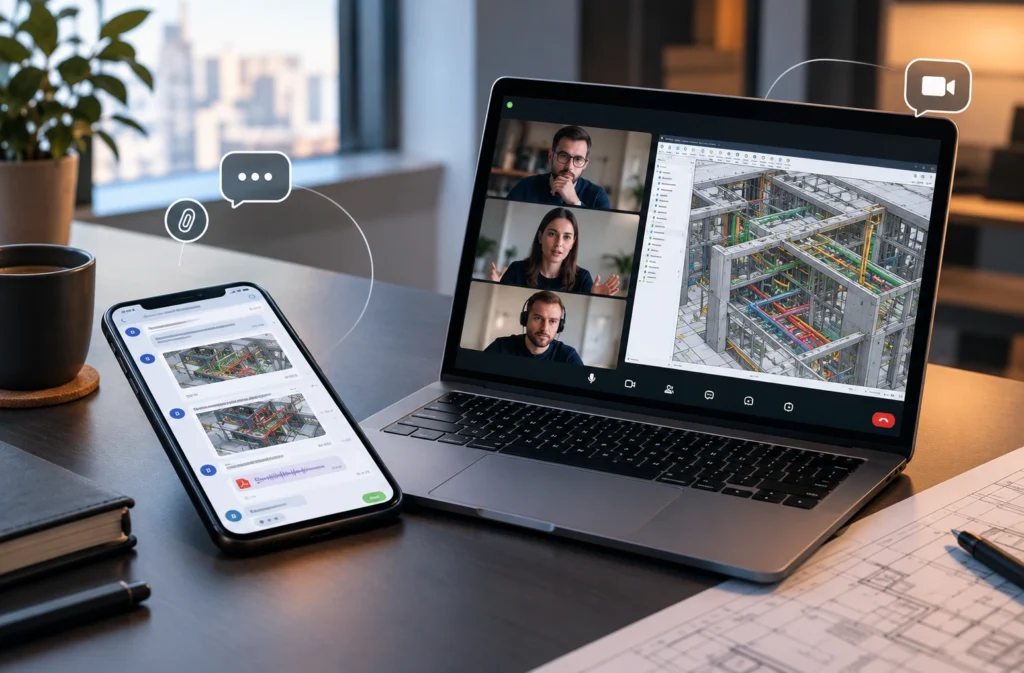
In remote and international projects, teams now solve most work-related questions online. We write in chats, send screenshots, PDFs, and voice messages, add comments to models, and wait for the client’s response.
And it works very well.
Until the question becomes more complicated.
Sometimes one message really saves time. But sometimes 15 minutes on Zoom can be faster than 30 messages and several hours of work in the wrong direction.
The key is to understand the difference.
Not Every Question Needs a Meeting
Let’s start with the obvious: setting up a call for every small question is not efficient either.
If you need to confirm a drawing number, get a file, confirm a deadline, or find out which model version to use, a short message is the best option.
Chat works especially well when the answer can be straightforward:
Yes / No.
Version 2026.
Use option B.
Please update sheet A-104.
Zoom is unlikely to make these questions faster.
But engineers cannot solve every question with one sentence.
When Chat Starts Taking Time
Imagine a different situation.
An engineer works on a Revit model and sees that a new architectural solution conflicts with an existing system.
The engineer takes a screenshot.
The client replies:
“Please move it slightly.”
The engineer asks:
“To the left or to the right?”
The engineer sends another screenshot.
Another specialist joins the discussion.
A third option appears.
After 25 messages, the team is no longer discussing only the element’s position. They are also trying to figure out which drawing version everyone is looking at.
At this point, chat has stopped saving time.
This is where a short video call with the client can work much better.
Open the model. Show the problem. Check two options. Confirm the decision.
15 minutes – and everyone sees the same thing.
A Simple Rule: If You Need to “Show” Something, Consider a Call
Text works well for facts.
But it does not always explain spatial decisions clearly.
This matters especially in BIM, Revit, AutoCAD, GIS, structural design, or MEP, where you may need to see the model, drawings, several systems, and the consequences of a change at the same time.
If you are already preparing a third screenshot with red arrows and writing a long explanation, it may be time to say:
“Can we have a quick 10–15 minute call?”
This does not mean that the engineer cannot explain the problem.
Instead, it shows that the engineer knows how to choose the tool that can solve it faster.
When Does 15 Minutes on Zoom Really Make Sense?
A short call can help when:
- there are several possible technical solutions;
- you need to show the problem directly in the model;
- the client’s comment can have several interpretations;
- the change affects several disciplines at once;
- the chat already contains many follow-up questions;
- the team works with different versions of the information;
- a misunderstanding could lead to several hours of rework.
So you do not need a meeting simply because a question is “important.”
You need one because it is faster to see and discuss the issue than to describe it.
But There Is Another Problem: Zoom Without a Result
The other extreme is a 40-minute meeting where everyone discusses the issue, says goodbye…
and two hours later you receive a message:
“So, which option did we approve?”
A video meeting does not replace documenting the decision.
After the call, you need a short written result.
For example:
Approved: Option B.
Engineer updates the model.
New drawing will be uploaded by Thursday.
Three lines.
Now chat and Zoom work together instead of competing with each other.
The call helped the team make the decision quickly.
The message recorded it for everyone.
Good Communication Does Not Mean More Communication
Sometimes people think a strong remote engineer needs to stay online all the time, write a lot, and hold regular meetings.
In reality, communication effectiveness does not depend on the number of messages or calls.
What matters is this:
Did the team get the right information at the right time?
Professional communication means that an engineer knows:
when one message is enough;
when it is better to add a screenshot;
when the team should record a question in an email or comment;
and when five minutes of verbal explanation can save an hour of chat.
This is just as much a part of the engineering workflow as working with models, files, or documentation.
What If the Client Is in a Different Time Zone?
Here, chat clearly has an advantage.
International projects often work asynchronously. When one team starts its workday, another team may already be finishing theirs.
In this situation, you do not need to move every question to Zoom.
Instead, a good message should let the other person answer without asking more questions.
Add a screenshot. Mark the problem. Suggest two options. Explain which decision you need.
If the question still requires discussion, arrange a short call during a shared working time.
The Most Expensive Thing Is Not a Message or Zoom
The most expensive thing is starting work without getting a clear answer.
The engineer thinks:
“I think the client meant this.”
The engineer works for two hours.
Then sends the result.
And gets:
“No, that’s not what I meant.”
That is where the real time loss happens.
So five minutes spent clarifying a question is not a project delay.
Sometimes it is the fastest part of the job.
FAQ
It depends on the question. A message is enough for short, straightforward questions. For complex technical decisions that require you to show something in a model or drawing, a short call can often work better.
When the conversation becomes long, the task has several possible interpretations, or a wrong decision could lead to significant rework.
If you need to solve one specific question, 10–15 minutes is often enough. Before the call, make sure you know which decision you need to reach.
Yes. A short written record helps prevent different interpretations of the agreement and gives the team a clear reference.
Yes. Working on a real project involves more than knowing the software. Engineers need to receive project information, ask clarifying questions, agree on solutions, and pass results to other team members.
30 messages or 15 minutes on Zoom?
There is no single right answer.
Sometimes the fastest tool is one sentence in the chat.
Sometimes it is a screenshot.
And sometimes you simply need to open the model together and say:
“Here. Look at this.”
A strong engineer does not choose between messages and meetings.
They choose the shortest path to a clear solution.
If you are developing your skills in BIM, Revit, AutoCAD, GIS, or another AEC field and want to work on real international projects, explore current vacancies and professional opportunities at join-jot.com or send us your CV.