How to write an engineer’s CV that gets you invited to interviews
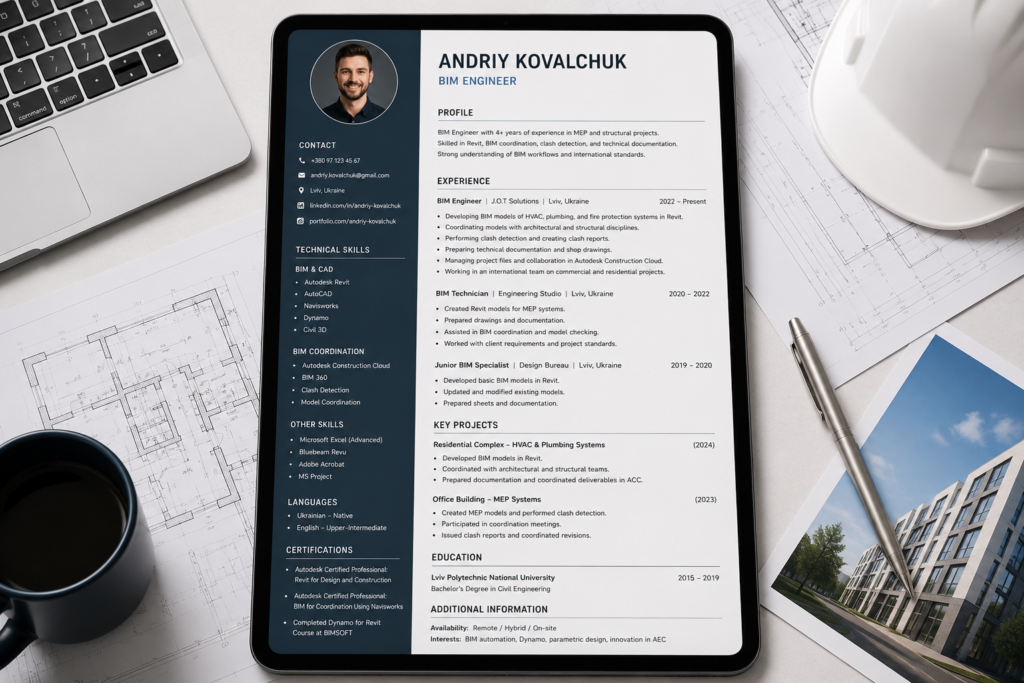
Imagine two candidates.
Both know Revit. Both have worked with drawings. Both are looking for a job in engineering or the BIM field.
But one of them gets invited to interviews almost every week.
The other CV gets lost among dozens of others.
The reason is often not experience.
The reason is how that experience is presented.
In engineering, Building Information Modeling (BIM), Geographic Information Systems (GIS), and Architecture, Engineering and Construction (AEC) fields, your CV is the first impression of you as a specialist. And in most cases, employers make a decision within the first 20–30 seconds of reviewing it.
That’s why a modern engineer’s CV is no longer just a document. It is your professional presentation.
Why most engineers’ CVs look the same
“Worked in Revit.”
“Created drawings.”
“Participated in projects.”
The problem is that such phrases say nothing about your real level.
In technical fields, employers want to see:
- what systems you worked with
- your workflow
- whether you can work in a team
- whether you are ready for international projects
- whether you understand BIM coordination and remote collaboration
And this is where the difference between a “standard CV” and a CV that actually works begins.
How to write an engineer’s CV that gets read to the end
There is a simple rule:
A good CV should be easy to scan even for someone who opens it at 8 a.m. among 40 other resumes.
That’s why structure is critical.
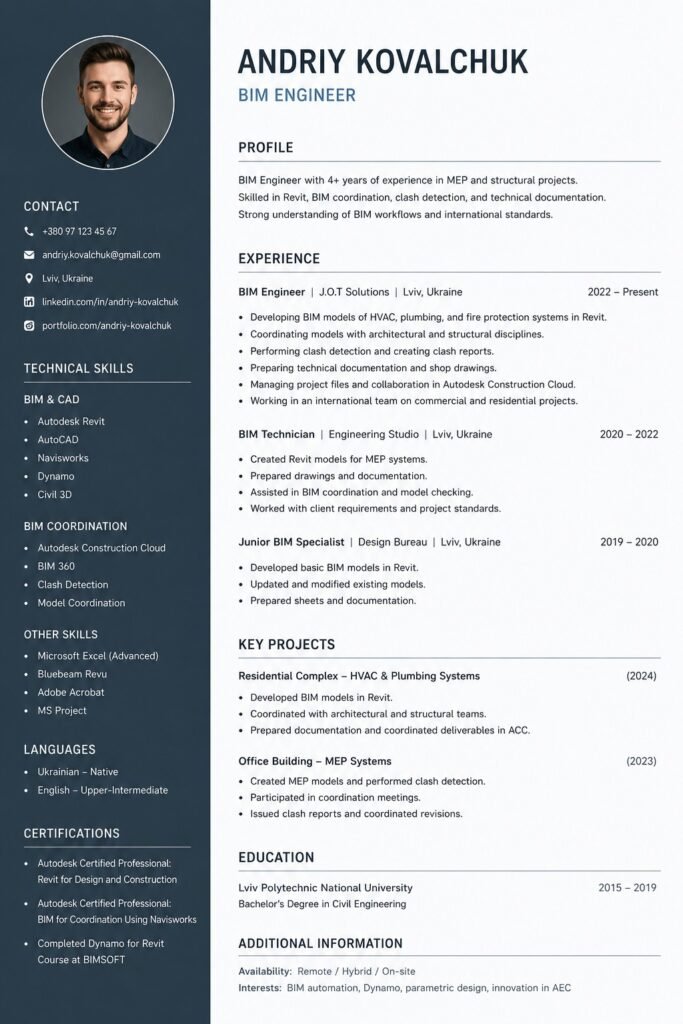
What a CV should include:
- contact information
- short professional summary
- technical skills
- work experience
- education
- certificates
- portfolio
And yes — today, a portfolio is often more important than a long list of responsibilities.
Especially in BIM, Revit, GIS, CAD, and architectural roles.
Technical Skills — the first section people look at
Many candidates underestimate this part.
But in engineering, HR or team leads often first look for:
- Revit
- AutoCAD
- Civil 3D
- Navisworks
- QGIS
- Autodesk Construction Cloud (ACC) / BIM 360
- Dynamo
And only then do they read the rest.
That’s why your technical stack should be:
- clear
- structured
- easy to understand
- without “fluff”
Instead of:
“Good knowledge of design software”
Better:
- Revit
- AutoCAD
- BIM Coordination
- Clash Detection
- Technical Documentation
- ACC Workflow
Immediately a stronger impression.
The biggest mistake in an engineer’s CV
Describing the process instead of the result.
For example:
❌ “Created models.”
✅ “Developed BIM models of HVAC systems for international residential projects.”
❌ “Worked with documentation.”
✅ “Prepared technical documentation package for a façade project.”
In engineering, specificity always looks stronger.
English CV is no longer a “plus” — it’s a necessity
Even if you are not currently looking for a job abroad.
Why?
Because international projects, remote teams, and outsourcing workflows are now standard in the BIM and AEC industry.
And very often, an English CV is what opens new opportunities.
But it’s important not to “Google Translate” it — it should be written professionally and simply.
For example:
- technical documentation
- BIM coordination
- MEP systems
- structural design
- remote collaboration
These are the terms used by international teams.
What if you don’t have experience yet?
This is a question almost every junior engineer or student asks.
And here is the good news:
in BIM and engineering, even academic projects matter.
If you have:
- a Revit model
- drawings
- a GIS project
- coursework
- a certificate
- a workshop
- a pet project
— you can and should show it.
Because employers often look not only at experience, but also at potential.
CV for remote jobs: what companies look for now
Remote work in engineering is already standard for many teams.
But for remote roles, employers evaluate more than just technical skills.
They look at:
- how you communicate
- whether you can work independently
- whether you understand workflows
- whether you have worked with Autodesk Construction Cloud (ACC) / BIM 360
- whether you participated in coordination meetings
That’s why even one line like:
“Worked in remote international teams”
can significantly strengthen your CV.
And one more important thing — design
In engineering, a CV should not look like an advertisement banner.
What works best:
- clean design
- plenty of whitespace
- clear sections
- PDF format
- 1–2 pages maximum
And yes — a file named
“final_cv_new_REAL_last2.pdf”
should never be sent.
A good CV doesn’t “search for a job”. It creates opportunities
A strong resume is not about making it look nice.
It is about showing:
- how you think
- how you work
- what problems you can solve
- how ready you are for real engineering projects
Especially now, when Building Information Modeling (BIM), Geographic Information Systems (GIS), and the AEC industry are evolving rapidly, and international companies are increasingly looking for specialists for remote collaboration.
If you want to grow in engineering, BIM, or international projects — explore opportunities, vacancies, and internships at J.O.T Solutions. Sometimes, a single well-prepared CV is the beginning of a big professional story.