Remote Work for Engineers: How the Format Really Works and Who It Is Suitable For
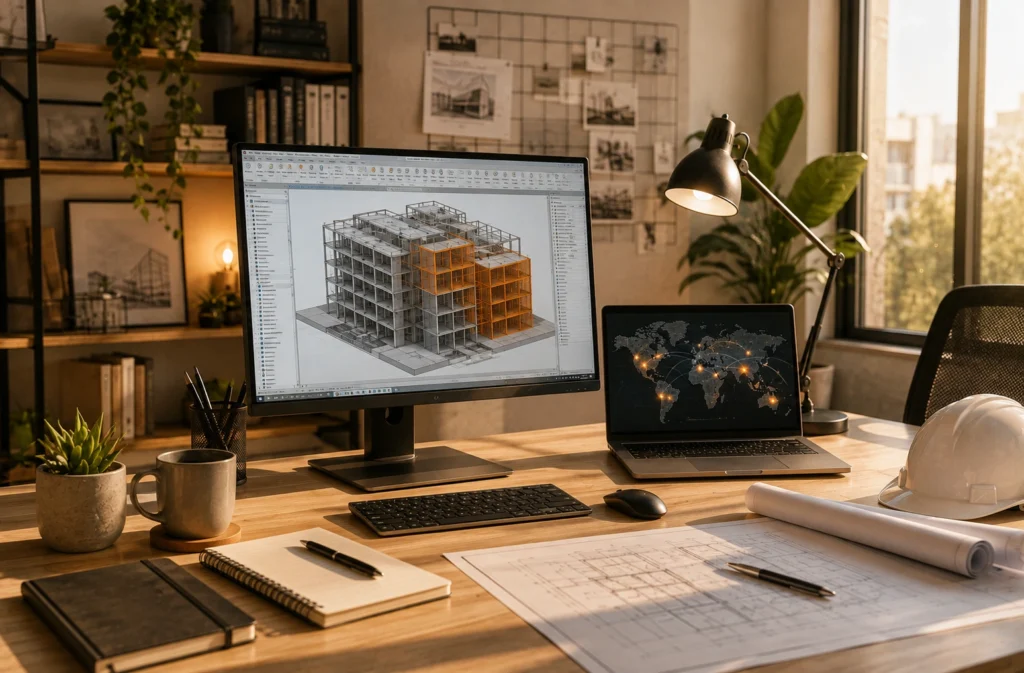
Just a few years ago, remote work for engineers seemed more like an exception than the norm. It was widely believed that design, model coordination, and technical documentation required constant presence in an office. BIM technologies and cloud-based platforms have changed this perception. Today, structural engineers, architects, MEP engineers, BIM coordinators, and GIS specialists increasingly work from home or any other location while remaining fully integrated into their teams.
In this article, we will explore how remote work in engineering and architecture actually works, whether remote work without experience is possible for junior candidates and students, and what role English proficiency plays in accessing international projects.
What Is Remote Work for an Engineer and How Does It Differ from an Office-Based Format?
Remote work for technical specialists rarely means having no communication with the team. In most cases, it follows a hybrid model: engineers complete most tasks independently, including Revit modeling, calculations, and technical documentation, while coordination with colleagues takes place through regular online meetings and shared access to BIM models.
The key difference from an office-based format is not the volume or complexity of the work, but the way the workflow is organized. Instead of in-person meetings, teams use video calls; instead of paper documentation, they use cloud platforms for collaborative work on models; and communication more often takes place through messengers or corporate email.
For the AEC industry, this has become possible due to the widespread adoption of BIM workflows, where a model is not simply a static file but a live environment that architects, structural engineers, and MEP engineers can access simultaneously, regardless of their physical location.
Which Engineering Fields Are Best Suited to Remote Work?
Not all engineering tasks can be transferred to a remote format equally well. The fields most suitable for remote work include:
BIM modeling and coordination. Working directly in Revit or other BIM platforms, creating families, and coordinating clashes between disciplines can all be performed on a computer without requiring physical presence at a construction site.
Structural design. Structural calculations and the preparation of construction documentation in CAD or BIM environments can also be adapted well to remote work, except for stages that require visits to a construction site.
GIS analysis. Working with spatial data, creating maps, and preparing analytical reports can be performed almost entirely remotely.
MEP design. Designing building systems and engineering networks within a BIM model is also well suited to remote work, particularly during the design stages rather than on-site inspections.
At the same time, positions related to construction supervision, site inspections, or direct interaction with contractors on-site require physical presence and are rarely fully remote.
Remote Work Without Experience: Is It Possible for Junior Candidates?
One of the most common concerns among students and junior candidates is that remote work without experience is inaccessible because companies supposedly only trust experienced specialists to work remotely. In reality, the situation is more complex and depends on several factors.
Companies that systematically operate remotely usually have established processes for onboarding new employees online, including mentoring, step-by-step instructions, and regular progress reviews. In such teams, a junior specialist can absolutely start their career remotely if they demonstrate basic technical skills — knowledge of Revit, AutoCAD, or GIS through educational or practice projects — as well as a willingness to communicate actively about their progress.
Finding remote work without experience can be more difficult in companies that do not have an established system for training new employees online. In such organizations, preference is often given to candidates who have already experienced an office-based onboarding process. Therefore, for junior candidates, a logical strategy is to look specifically for internships or trainee programs with remote options, where mentoring is built into the process from the beginning.
It is also important to understand that a lack of professional office experience can be partially compensated for by a strong portfolio. Educational projects, BIM coursework, and participation in student architecture competitions can all demonstrate a candidate’s level of preparation even without formal work experience.
Remote Work with English: When Language Becomes a Key Requirement
Not every remote position requires English. Some Ukrainian companies hire remote employees for local projects where communication takes place primarily in Ukrainian. However, if the goal is remote work with English and access to international projects, language skills become not just an additional advantage but a basic requirement.
This is because international teams typically:
- Prepare technical documentation and communicate by email in English.
- Hold coordination meetings involving colleagues or clients from different countries.
- Use BIM standards and terminology adopted in international practice, which may differ from local terminology.
For candidates who want to transition to international projects, it is worth improving their technical English in advance — not just general conversational English, but terminology related to Revit, structural design, MEP, or GIS. This can significantly speed up adaptation to a new team and increase confidence during the first calls.
How to Organize Your Own Workflow for Remote Work
Remote work requires a higher level of self-organization than working in an office because there is no manager or colleague physically nearby to remind you about deadlines. Here are several practical tips:
- Plan your day in a structured way. Separate time for deep, focused work such as modeling and calculations from periods dedicated to communication with the team.
- Document your progress. Regular short updates about completed tasks help the team understand the project’s status without constant additional questions.
- Set up convenient access to BIM models and cloud-based tools. A stable internet connection and familiarity with collaborative platforms are basic technical requirements for remote positions.
- Maintain regular contact with your team. Even when daily meetings are not mandatory, proactively communicating your progress or questions can help avoid misunderstandings and feelings of isolation.
Advantages and Limitations of Remote Work for Engineers
The advantages of remote work include greater flexibility, access to international projects regardless of location, and the time saved by eliminating commuting. For specialists who have relocated or live in regions with a limited number of local vacancies, remote work can often be the only way to continue building a career in their field.
At the same time, the format has its limitations. It can be harder to receive quick informal feedback that would naturally happen through face-to-face communication in an office. Remote work also requires greater personal discipline, while some engineering tasks — such as site inspections — simply cannot be performed remotely.
Therefore, for many teams, a hybrid model remains the optimal solution, combining remote work on models and documentation with occasional in-person meetings or site visits.
Frequently Asked Questions About Remote Work for Engineers
Yes, especially through internships or junior positions at companies with established online onboarding systems. A strong portfolio of educational projects can significantly increase your chances.
It depends on the type of projects. English is not always required for local Ukrainian teams, but remote work with English opens access to international projects and a wider range of job opportunities.
BIM modeling, structural design, GIS analysis, and MEP design are well suited to remote work because they are primarily performed on a computer.
Yes. You need a computer that meets the system requirements of software such as Revit or AutoCAD, a stable internet connection, and access to cloud platforms for collaborative work on models.
Yes. Many students in technical fields combine their studies with remote internships or part-time positions, allowing them to gain practical experience before graduation.
No. Positions involving construction supervision or on-site inspections require physical presence, so these roles are more often hybrid rather than fully remote.
If you are considering remote work in engineering or architecture, check out the latest remote job opportunities on join-jot.com, submit your CV or apply for an internship to gain your first experience working remotely with a team involved in international projects.